
NOTICE: In coming weeks, we will close this Illuminations page and delete the archives. But don’t worry, this work goes on! Please subscribe to Lectionary Reflections on Substack to continue receiving these weekly comments without charge.
Illuminations on the Lectionary readings for Oct. 4, 2026 (Pentecost 19A/Proper 22)
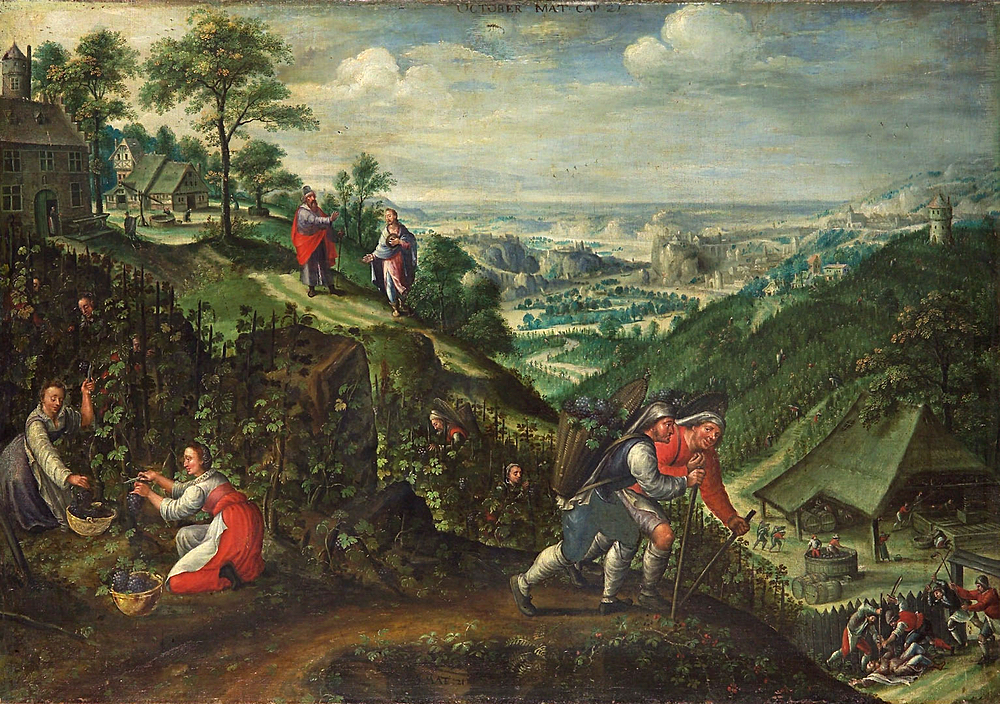
Parable of the wicked tenants (c.1580-1590), oil painting on canvas by Marten van Valckenborch (1535-1612). Kunsthistorisches Museum, Vienna. (Click image to enlarge.)
First Reading (Track One): Exodus 20:1-4, 7-9, 12-20
When God commands, the people try to obey; but it isn’t always easy. Listen for this theme through Sunday’s readings. In this first reading, the people in their wandering through the desert come to a significant encounter at Mount Sinai: Establishing their identity and their hope, they join with God in a lasting covenant. Through Moses they receive the ten commandments that will guide their lives and ensure their righteousness in relationship with God and others. Through the commandments God tests our faith, Moses warns them: “God has come to test you and to put the fear of him upon you so that you do not sin.”
First Reading (Track Two): Isaiah 5:1-7
The Bible is filled with metaphors involving wine, the fruit of the vine, and the vineyards from which wine comes. In this poetic song from Isaiah, God plants a vineyard and cares for it with love. But the harvest yields “wild” grapes, a word that means stinking, worthless, or sour in the original Hebrew. These rogue vines symbolically stand for the people, who disappointed God by failing to be just and righteous. Now, Isaiah prophesies, God will trample down the vines, destroying the vineyard.
Psalm (Track One): Psalm 19
God’s commandments are a wonderful gift, the Psalmist declares in this triumphant hymn as it begins with mighty praise for the beauty of all God’s creation. The commandments are a gift that shows God’s glory in such a shining light that all the heavens sing. All the skies reveal the work of God’s hand! Then the theme turns to God’s commandments, God’s law and teaching. True, just and righteous, God’s commandments stand even above the earthly creation that we have just celebrated, the Psalmist sings: They are sweeter than honey, more precious than gold.
Psalm (Track Two): Psalm 80:7-14
Surely the Psalmist had Isaiah’s book at hand while writing these poetic verses. In the first reading, Isaiah had warned that a disappointed, angry God, loathing the sour fruit, would demolish the vineyard, tearing down its wall and hedge and ordering a drought to lay it waste. Now these verses of Psalm 80 imagine a people who brought a vine out of Egypt, made it mighty, but then neglected it and let it wither. Now they beg a compassionate God to regard and restore the bountiful vines, in a suggestion of hope that was absent from Isaiah’s dark verses.
Second Reading: Philippians 3:4b-14
The verses just preceding this reading provide needed context: After Paul left Philippi, other Christians preaching a more rigid Jewish Christianity arrived and told the people of this Macedonian church that Paul’s teaching was wrong. They must strictly follow Jewish law. including purity laws and circumcision, in order to be Christians, these interlopers told this community of Gentile converts. Paul warned the Philippians to beware of these teachers, calling them “dogs … evil workers … those who mutilate the flesh!” Now Paul reminds them that he is a devout Jew himself, a Pharisee, observant and righteous. But now, he says, everything has changed: The old commandments mean nothing without Christ as the context in which to hear them.
Gospel: Matthew 21:33-46
Jesus, still arguing with the temple authorities, tells another challenging parable set in a vineyard: Its owner has gone to another country, hiring tenants to tend the vines for him. When he sends his slaves to get the produce, though, the tenants beat them up and kill them. They do the same to another group of slaves the owner sends after that. Then, incredibly, when the owner sends his own son, the tenants kill him, too! What, Jesus asks, should the owner do? Surely he will kill the evil tenants, the priests and Pharisees respond. But Jesus gives the parable yet another twist, declaring that those who work to produce the fruit will be the ones who inherit the Kingdom of God. Angered, the temple leaders start plotting to arrest Jesus.