
Illuminations on the Lectionary readings for July 5, 2026 (Pentecost 6A/Proper 9)
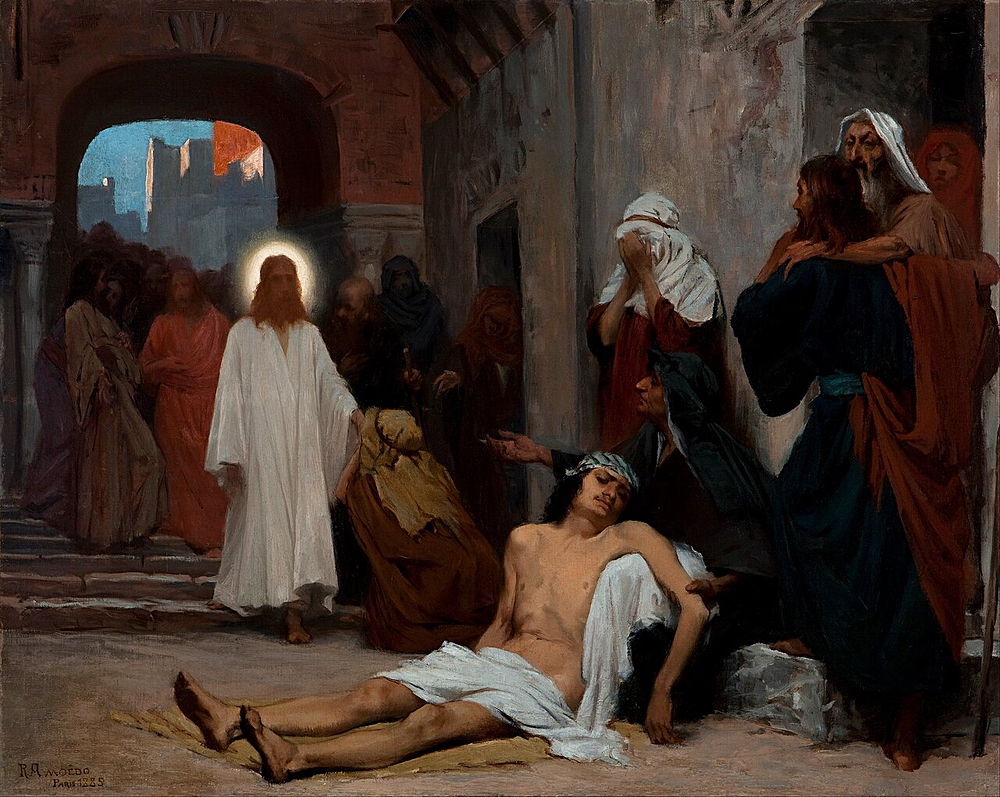
Jesus in Capernaum (1885), oil painting on canvas by Rodolpho Amoêdo (1857- 1941). Pinacoteca de São Paulo, Brazil. (Click image to enlarge.)
First Reading (Track One): Genesis 24:34-38, 42-49, 58-67
When God calls you, listen and follow. This consistent theme in Sunday’s readings begins with Rebekah’s response to Abraham’s servant in this first reading. She reminds us of Abraham’s acceptance of God’s call. Both answered with faithful trust when they heard God’s voice. Abraham uprooted his family and moved to a new land far away. Rebekah left her home and family to marry Abraham’s son, Isaac, whom she has not yet met but who will come to love her. Abraham heard God’s promise that his offspring would become a great and mighty nation. Rebekah, with her own strong faith, heard that her children would become “thousands of myriads.”
First Reading (Track Two): Zechariah 9:9-12
In this brief passage, Zechariah – one of the last of the Hebrew Bible’s dozen so-called minor prophets – celebrates the people’s return from exile and their hope of restoring the Temple. He prophesies that a humble yet powerful king will come to reign in peace and restore the nation’s prosperity. The evangelist we know as Matthew will later imagine Jesus so vividly foretold in these verses. His gospel adopts Zechariah’s wording so precisely that it even retains the poetic repetition of Hebrew verse – “riding on a donkey; on a colt, the foal of a donkey” – in his startling image of Jesus’s triumphal entry into Jerusalem on two animals.
Psalm (Track One): Psalm 45:11-18
Psalm 45 is a blessing for a wedding. It is a love song addressed to a princess bride of Tyre (an ancient island kingdom and occasional rival to Israel), who has come to Israel to be joined in a royal marriage. This passage celebrates the pomp and joy of her coming wedding. It also highlights the Psalmist’s hope that the bride will be remembered and praised in future generations, a wish that echoes God’s promises of myriad descendants to Abraham and Rebekah.
Alternate Psalm (Track One): : Song of Solomon 2:8-13
The Song of Solomon, also known as the Song of Songs, is a lyrical collection of ancient Hebrew love poetry. Curiously, this book and the book of Esther are the only books in the Bible that do not explicitly mention God. Rather, we are invited to find the image of God in the joy of giving and caring love. These verses are understood as a rhapsodic song of springtime, but their metaphorical evocation of love in the midst of an awakening springtime Earth speaks to our hearts even during the heat and sunshine of July.
Psalm (Track Two): Psalm 145:8-15
Like many of the psalms, this hymn of praise is traditionally attributed to the hand of King David. It parallels the reading from Zechariah in its vision of a humble, powerful king who reigns in peace and prosperity. The Psalmist portrays this kingdom of glorious splendor not simply as a reign for here and now, but one that will be known in glory to all people: an everlasting kingdom that will endure through all the ages.
Second Reading: Romans 7:15-25a
In recent readings from Paul’s letter to the Romans, we have heard his assurances that through baptism we metaphorically die to our old lives enslaved to sin, only to be born to a new life freed from sin through the free gift of grace from God. In this passage, though, pointing to himself as a bad example of a “wretched man,” Paul declares that it’s not easy to leave sin behind, even when we want to do the right thing. He tries, but he can’t get rid of the sin that lives within him, he writes. We can’t fight sin on our own without God’s help through Jesus, who frees us from the slavery of sin.
Gospel: Matthew 11:16-19, 25-30
Jesus seems frustrated, even angry, in the opening verses of Sunday’s Gospel. Preaching to crowds around Capernaum in Galilee, he likens them to children and infants calling out and playing. Perhaps he is feeling irritable because some of the same people who considered the ascetic John’s call for repentance crazy and judgmental are now criticizing Jesus’s joyous embrace of life as evidence that he is a glutton and a drunk. But then, after we skip over five additional angry verses not included in Sunday’s reading, Jesus pauses and thanks God. His words of hope for Israel’s children and infants turn gentle as he invites all who carry heavy burdens to come to him and find rest for their souls.