
Illuminations on the readings for July 4, 2026 (Independence Day)
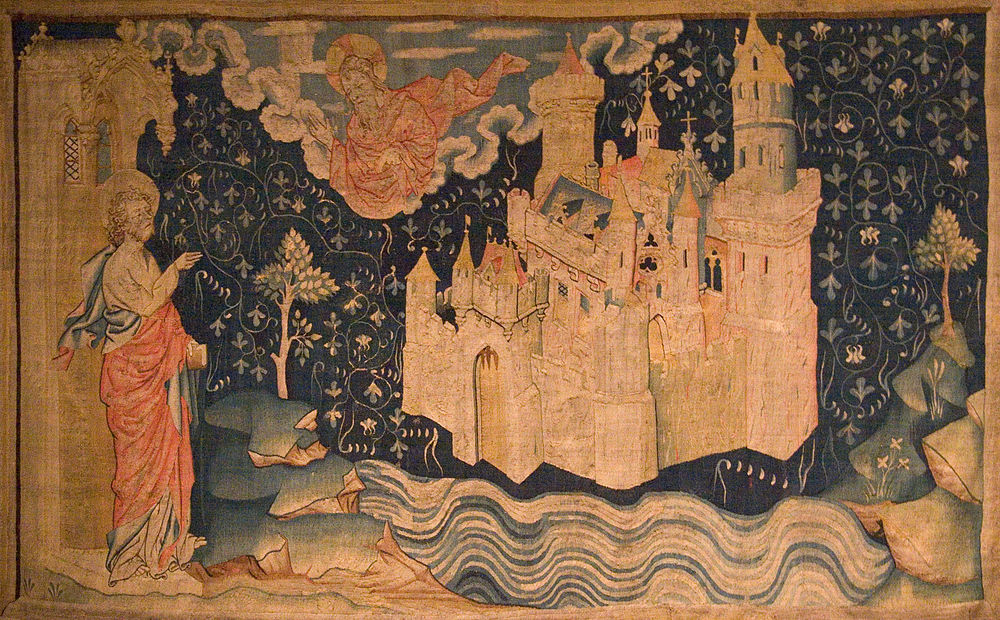
John of Patmos observes the descent of the New Jerusalem, Angers Apocalypse tapestry (1373-1387) by Jean de Bondol (14th century). Musée de la Tapisser ie, Château d’Angers, France. (Click image to enlarge.)
On July 4th, the Episcopal Church joins the United States in celebrating Independence Day, marking the day the country declared independence from the Kingdom of Great Britain in 1776, 250 years ago.
The Episcopal Church offers two possibilities for lectionary readings: The Revised Common Lectionary for a Eucharist (BCP 930), or the Daily Office Lectionary (BCP 998) for Morning or Evening Prayer. (Scroll down to Independence Day, July 4.)
The overall thread for the Independence Day readings tends to reflect the sentiments expressed in one of the Collects used for the day, The Collect for the Nation (BCP page 258), in which we pray, “Lord God Almighty, you have made all the peoples of the Earth for your glory, to serve you in freedom and in peace: Give to the people of our country a zeal for justice and the of forbearance, that we may use our liberty in accordance with your gracious will.”
The Revised Common Lectionary
First Reading: Deuteronomy 10:17-21
Having received the tablets of the commandments, again, after Moses shattered the originals upon finding the people worshiping a golden calf, Moses now receives wisdom about governance that would be well taken by modern nations: God, mighty and awesome, is not partial and takes no bribe. God executes justice for the orphan and the widow, and loves the strangers, providing them food and clothing. “You shall also love the stranger, for you were strangers in the land of Egypt.”
Psalm: Psalm 145 (or 145:1-9)
Psalm 145, a hymn to the goodness and greatness of God, envisions God as a humble, powerful king who reigns in peace and prosperity. This kingdom of glorious splendor is clearly understood not only as a kingdom for here and now, but one that is known in glory to all people, an everlasting kingdom that endures through all the ages. While extolling God as a mighty one of unsearchable greatness, whose mighty acts will always be remembered, it also praises God as gracious and merciful, slow to anger and abounding in steadfast love; good to all, with compassion over all.
Second Reading: Hebrews 11:8-16
The intended audience for the letter to the Hebrews was probably a community of Jewish Christians who, fearing persecution, were considering a return to Judaism. The author of Hebrews works to persuade them that Christianity is the better way, sometimes in terms that can sound almost anti-Semitic to modern ears. In this passage, though, the author takes care to speak well of the Abrahamic tradition, declaring that God has prepared a heavenly homeland and city for them; that Jews and Christians will inherit the city of God through faith, beautifully described as “the assurance of things hoped for, the conviction of things not seen.”
Gospel: Matthew 5:43-48
The Gospel for Independence Day offers filling food for thought: In this short passage from the Sermon on the Mount, Jesus continues urging the crowd to go beyond the old teaching to follow a new way, hearing God’s commandments not only as rules to live by but as new ways to understand our relationship with God and our neighbors. How might Jesus’s followers react to his radical call to “love your enemies and pray for those who persecute you, so that you may be children of your Father in heaven”? What would a nation look like whose leaders and whose people lovingly followed all of Jesus’s call?
The Daily Office
Morning Prayer
Psalm: Psalm 33
Psalm 33 is a hymn of praise and thanksgiving for a just and faithful God who inspires the people’s songful worship and their fearful awe. The Psalmist sings of a God who loves righteousness and justice, who fills the Earth with steadfast love. Through God’s word, we hear, the heavens and earth and all that fills them were made: “He spoke, and it came to be. He commanded, and it stood firm.” Happy is the nation, the Psalmist sings, whose God is the Lord. Happy are those who are chosen as God’s heritage.
First Reading: Ecclesiasticus (Sirach) 10:1-8,12-18
Sirach, also known as Ecclesiasticus, is one of the group of books known as Apocrypha that come at the end of the Hebrew Bible. It sums up Torah, God’s teaching, in the genre of wisdom literature: brisk, memorable suggestions of spiritual advice. This passage from Sirach 10, appropriately for Independence Day, describes the behavior of a good magistrate and civic leader, whose rule is intelligent and well ordered. “Do not get angry with your neighbor for every injury,” it reminds those who live in an ordered society. “Do not resort to acts of insolence. Arrogance is hateful to the Lord and to mortals.”
Second Reading: James 5:7-10
“Be patient, therefore”? This passage seems to be starting in the middle of a thought. If we turn back a page to see what preceded “Therefore,” we find James excoriating the rich, specifically the selfish rich. “You rich people, weep and wail for the miseries that are coming to you. … You have laid up treasure for the last days. Listen! The wages of the laborers who mowed your fields, which you kept back by fraud, cry out, and the cries of the harvesters have reached the ears of the Lord of hosts.” We don’t hear all that in this Independence Day reading, though. We begin with the verses that followed, in which James calls us to follow the example of the prophets: Love each other and be generous with one another, lest we be judged.
Evenng Prayer
Psalm: Psalm 107:1-32
This long passage from Psalm 107 hails God’s steadfast love, a poignant Hebrew word – “chesed” – that connotes compassion, faithfulness, kindness, mercy, and grace. “O give thanks to the Lord, for he is good, for his steadfast love endures forever.” The Psalmist invites us to repent, to turn back, to give thanks for God’s mercy with shouts of joy. Even when we are foolish, when we rebel, when we sin, when we are afraid, these verses offer reassurance: As soon as we cry out for God, God will respond to us as beloved children, granting us healing and salvation.
First Reading: Micah 4:1-5
As we think about America’s 250 years as an independent nation, we might hear the opening verses of Micah 4 as celebrating a shining city on a hill: “In days to come
The mountain of the Lord’s temple shall be established as the highest of the mountains and shall be raised up above the hills. Peoples shall stream to it, and many nations shall come.” But the prophet quickly reminds us that great power requires great responsibility: “They shall beat their swords into plowshares and their spears into pruning hooks; nation shall not lift up sword against nation; neither shall they learn war any more.”
Gospel: Revelation 21:1-7
In this apocalyptic vision, Heaven and Earth and all that is old have passed away, and everything is new! Earth and sea, all creation as we knew it, is no more. Reversing the idea that the souls of humans will rise to a lofty Heaven, we see God coming down from Heaven to Earth in a New Jerusalem, God coming to Earth to live with mortals as Jesus Christ had done. In verses often read during the remembrance of a loved one’s life, we hear that God will wipe away tears and banish mourning, crying, and pain; God will quench all thirst with the water of life, and death will be no more!