
NOTICE: In coming weeks, we will close this Illuminations page and delete the archives. But don’t worry, this work goes on! Please subscribe to Lectionary Reflections on Substack to continue receiving these weekly comments without charge.
Thoughts on Sunday’s Lessons for Oct. 25, 2026 (Pentecost 22A/Proper 25)
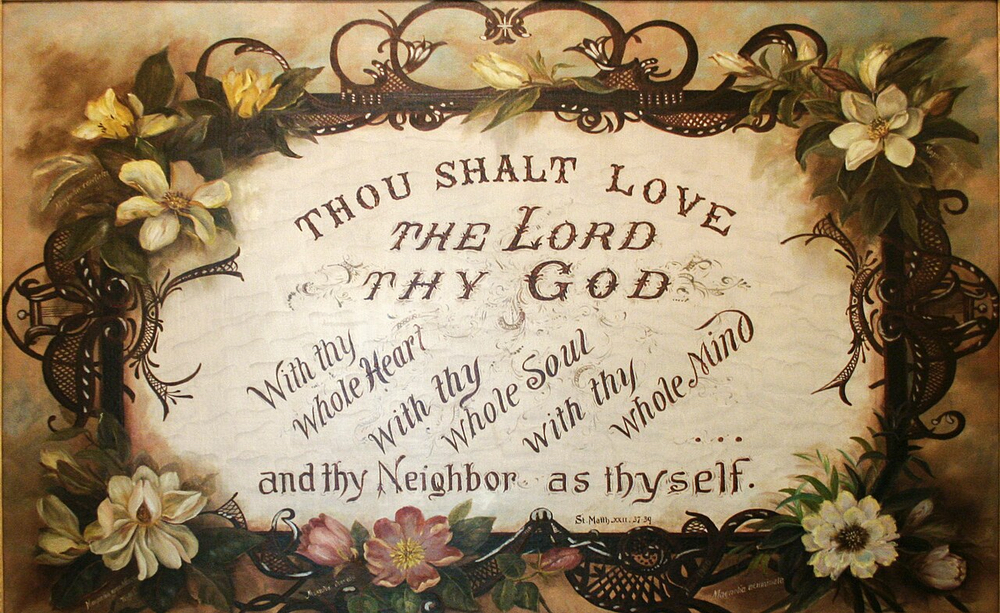
Thou shalt love the Lord thy God (Unknown date between 1847 and 1902), oil painting on panel by Maurice Schnell (1830–1902). Collection of the Sisters of Providence of Saint Mary-of-the-Woods, Indiana. (Click image to enlarge.)
First Reading (Track One): Deuteronomy 34:1-12
Hear this throughline in Sunday’s readings: Faithfulness is not measured by power, status, or personal achievement, but by love made real through service to others. This first reading comes at the end of the Torah, God’s Law and Teaching. Moses has led the people out of slavery in Egypt, received the commandments, and made a covenant with God at Mount Sinai. He has wandered 40 years in the desert with a fractious people. Now, coming within sight of the Promised Land, he meets God again on another mountaintop. He may see the land, knowing that God’s promise is fulfilled, but he won’t live to cross over to it.
First Reading (Track Two): Leviticus 19:1-2, 15-18
The overarching law that we are to love our neighbors as ourselves frames Sunday’s readings. We hear its roots in this first reading about an encounter between God and Moses. It returns fully developed in words of Jesus in Matthew’s Gospel. In a series of instructions that restate the moral code of the commandments, God’s words to Moses tell us how to be in good relationship with our neighbors. They culminate with the summary conclusion – the first place in the Bible where this is explicitly stated as a rule – that we shall love our neighbors as we love ourselves.
Psalm (Track One): Psalm 90:1-6, 13-17
A thousand years pass like a day in God’s continuing creation, we sing in these verses from Psalm 90, while our short lives are as brief as the grass that turns from green to brown overnight. Then in a second excerpt, the psalm’s tone turns from praise to petition as we ask God to hear our prayers, turn toward us with loving-kindness and make us glad.
Psalm (Track Two): Psalm 1
Psalm 1 sings concisely of the two paths that we may choose to take through life. In poetic verses that we could imagine inspiring Jesus’s parables about the seeds that fall on variously nourishing ground, the Psalmist likens humankind to trees. There are the lush, fruitful, and well-watered trees that symbolize righteous people who follow God’s way. And then there are the weak trees that can’t stand straight, illustrating the way of the wicked. Which way shall we choose?
Second Reading: 1 Thessalonians 2:1-8
It is fascinating to listen in as Paul tells the people of Thessaloniki about his serious problems with the congregation at Philippi, a neighboring community, where he declares that he suffered and was shamefully mistreated! Paul says he is grateful to the Thessalonians, though, for treating him kindly. They have built a dear friendship that Paul likens to a nurse caring for her children.
Gospel: Matthew 22:34-46
The words of Jesus about the greatest commandment may sound like a central tenet of Christianity, pouring directly from his heart. But this teaching is profoundly Jewish, too. The commandment that Jesus declares the “greatest and first” – to love God with all our heart, soul, and mind – exactly mirrors the Shema, the most important of all Jewish prayers. The Pharisees with whom he continues arguing certainly understood this. Then the second portion – to love our neighbors as ourselves – comes directly from the priestly codes in Leviticus. Our spiritual heritage goes back a long way. As we heard from Jesus earlier in Matthew’s Gospel, he did not come to abolish the Law and the Prophets (that is, the Tanakh, the Hebrew Bible) but to fulfill it.