
Illuminations on the Lectionary readings for March 29, 2026 (Palm / Passion Sunday A)
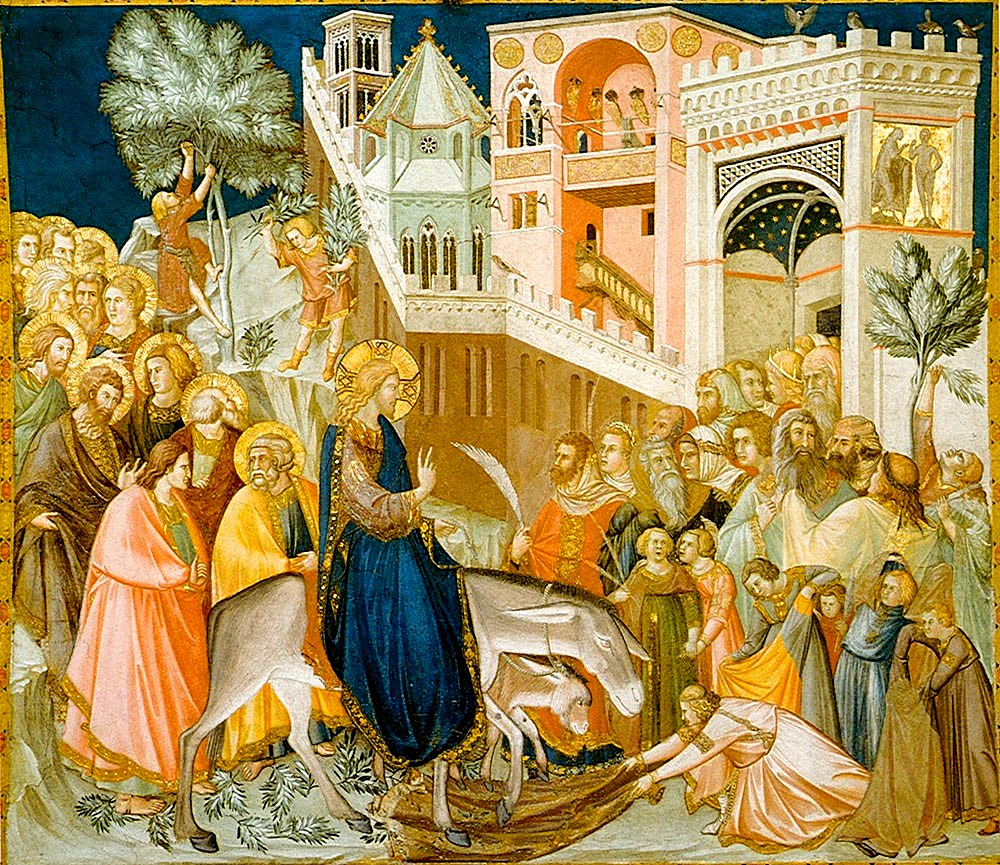
Christ’s entry into Jerusalem (1320), fresco by Pietro Lorenzetti (1280-1348). Basilica of San Francesco d’Assisi, Assisi, Italy. (Click image to enlarge)
Liturgy of the Palms A
Gospel: Matthew 21:1-11
If you think you remember Palm Sunday and Passion Sunday being celebrated separately on the two Sundays before Easter, there’s nothing wrong with your memory: They have been combined on the Sunday that begins Holy Week only since the ecumenical liturgy revisions in 1979. This combination creates a somewhat jarring experience in a liturgy that begins with Jerusalem’s crowds celebrating the arrival of Jesus as Messiah and King in the Gospel of the Palms, but then, in the same service, turning to shout “crucify him!” in the Gospel of the Passion. In the Gospel of the Palms, Matthew tells of Jesus’s triumphal procession into the city. Soon Jesus will anger the authorities again when he drives the money-changers out of the temple, as the Gospel narrative leads inexorably to his crucifixion.
Psalm: Psalm 118:1-2, 19-29
This portion of Psalm 118, a resounding ancient hymn in celebration of a victory, rings out in harmony with the celebration of Jesus’s arrival in Jerusalem. Imagine a joyful crowd at the gates to the ancient Temple, clapping hands and loudly singing, praising the Lord, our God, whose mercy and steadfast love endure forever. “On this day the Lord has acted; we will rejoice and be glad in it.”
Liturgy of the Passion A
First Reading: Isaiah 50:4-9a
When Christians hear Isaiah’s verses about the suffering servant, our thoughts naturally turn to Jesus Christ. The Creeds profess that Jesus was crucified for our sake, suffered death, and was buried. The Gospels reveal a Jesus who taught us to turn our cheeks to those who strike us, knowing that a peaceful response to enemies is no cause for disgrace. It is important to remember, though, that Isaiah was not writing for future Christians but directly to a Jewish audience in his own time. Isaiah prophesied to a people in exile in Babylon, a suffering body of faithful servants, all hoping and praying for a Messiah and King to lead them home.
Psalm: Psalm 31:9-16
The Psalmist who wrote these ancient verses of sorrow and lamentation might have had Isaiah’s Suffering Servant in mind. These verses also remind us of Job’s suffering as we chant this litany of sorrow, distress, grief, sighing, misery, scorn, horror, and dread. While the people suffer, the Psalmist sings, their neighbors scheme and even plot their death. As the Psalm continues, though, its tone gently changes from sorrow to hope. With faith in God, we sing, hope still glows for us like the sun breaking through clouds: We trust in God’s love. We wait to be saved.
Second Reading: Philippians 2:5-11
These poetic verses in Paul’s letter to the Philippians are rooted in a very early Christian hymn, an ancient confession in song that preceded the Creeds by three centuries. They declare that Christ was fully divine, yet fully human too, willing to set aside his divinity – “emptying himself” – to bear the horrific pain of crucifixion as a vulnerable, frightened human. Jesus took on the full weight of all that suffering to show us the true exaltation of God’s love, calling us only to respond with love for God and our neighbor.
Gospel: Matthew 26:14- 27:66 or Matthew 27:11-54
The Liturgy of the Passion readings reach their conclusion in Matthew’s long narrative of Jesus’s passion and death. There is much packed into these two chapters from Matthew, from Judas’s betrayal through the institution of the Eucharist; Jesus suffering in the garden, his arrest and trial, his journey to the cross and his death and burial. That’s a lot to grapple with all at once, so let’s reflect on one passage: When Jesus told the apostles during the Last Supper that one of them would betray him, every one of them was afraid. Every one, no matter how much he loved Jesus, wondered if he might be the traitor. Each in turn asked, “Surely not I, Lord?” As are we, they are human, frail, and weak. And Jesus, loving us still, takes up the cross.
(As an abbreviated alternative, this Gospel may be shortened to include only verses 27:11-54. This passage recalls the events from the arrest of Jesus to his death on the cross. It ends with a foreshadowing of the resurrection with the opening of the tombs and the Roman centurion and soldiers recognizing Jesus as truly God’s Son.)