NOTICE: In coming weeks, we will close this Illuminations page and delete the archives. But don’t worry, this work goes on! Please subscribe to Lectionary Reflections on Substack to continue receiving these weekly comments without charge.
Illuminations on the Lectionary readings for Oct. 18, 2026 (Pentecost 21A/Proper 24)
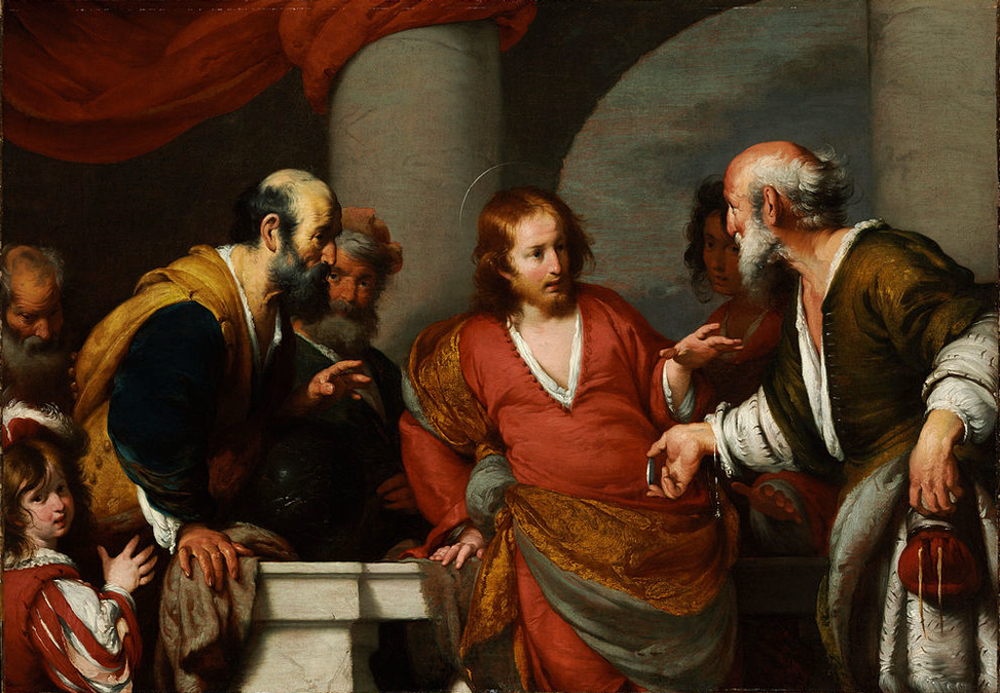
The Tribute Money (1630s), oil painting on canvas by Bernardo Strozzi (1581-1644). Museum of Fine Arts, Budapest. (Click image to enlarge.)
First Reading (Track One): Exodus 33:12-23
God’s power for good amazes us, and we follow in faith. This hopeful theme resonates through Sunday’s readings. For this first reading, we skip over a couple of chapters of bloody and horrifying narrative since hearing of God’s anger over the golden calf in last Sunday’s reading. Now Moses worries that his troublesome flock might stray again. He prays for assurance that God will continue to lead and guide the people. God agrees, but Moses wants more: He asks to see God. But, God warns, no human can survive seeing such glory as God’s face. A compromise emerges: Moses may stand in a crack in a rock, protected from danger, then open his eyes for a quick glimpse from behind after God passes by.
First Reading (Track Two): Isaiah 45:1-7
It may seem unusual to read high praise for a Gentile king in the Hebrew Bible, but in this passage from Isaiah, the prophet declares Cyrus, the king of Persia, “God’s own anointed,” literally using the Hebrew word “Messiah.” As is usual with Scripture, historic context is everything. The people had been in exile in Babylon for 40 years, dreaming of the city of Jerusalem and their beloved temple, all now destroyed. They had broken the covenant with God that had earned them the Promised Land when they failed to love their neighbor and care for the weak and needy. Now, led by the wise king that history knows as Cyrus the Great, the Persians have conquered Babylon, and Cyrus has sent them home, showing that even a Persian king may respond to God’s command.
Psalm (Track One): Psalm 99
Psalm 99 echoes the ideas that we heard in the first reading from Exodus. As we chant this Psalm, we sing loud praise to God’s great and awesome name. We celebrate God’s justice and equity. We remember that God, leading the people in a pillar of cloud, answered their prayers, but also punished them for their evil deeds, and finally forgave them in the end. Proclaim the greatness of the Lord, our God, the Psalmist sings.
Psalm (Track Two): Psalm 96:1-9, (10-13)
This portion of Psalm 96 mirrors Isaiah’s praise for Cyrus, the great Persian king, with a brisk reminder that God remains king among all kings, before whom the whole Earth trembles. God created all things and will judge all things, fairly and with equity, the Psalmist sings. Heaven and earth, thunder and lightning, all the fields and all the forest will rejoice when God comes to judge in righteousness and truth.
Second Reading: 1 Thessalonians 1:1-10
This Sunday we begin a five-week visit with Paul’s first letter to the small community in Thessalonica in Northern Greece. This is thought to be the earliest surviving document in the New Testament, probably written around 50 CE, within the first generation after the Crucifixion. The Thessalonian Christians had been persecuted for giving up the dominant Roman religion that Paul and the early Christians considered pagan. Their faith, Paul says, had inspired many converts, who were now waiting for Jesus to rescue them “from the wrath that is coming.” Many Christians in this early time fully expected Jesus to return within their lifetimes to judge the world and establish the kingdom of God on Earth.
Gospel: Matthew 22:15-22
Jesus, in Jerusalem in the last week before his passion and death, continues fencing with a group of Pharisees and temple leaders who have been plotting to have him killed. Now they try to trap Jesus with yet another trick question. Depending on his answer, they hope he will either anger the crowds by seemingly supporting Roman taxation, or risk treason against Rome by denying the emperor’s power. But Jesus outwits them as usual. He asks them to show him a coin, which reveals that they are casually carrying a forbidden graven image— the head of Tiberius Caesar— on each coin. Finally, when he tells them, “give to the emperor the things that are the emperor’s,” Jesus leaves open the question of just how much that might be … and how much of our lives, on the other hand, we should give to God.