
NOTICE: In coming weeks, we will close this Illuminations page and delete the archives. But don’t worry, this work goes on! Please subscribe to Lectionary Reflections on Substack to continue receiving these weekly comments without charge.
Thoughts on Sunday’s Lessons for Sept. 27, 2026 (Pentecost 18A/Proper 21)
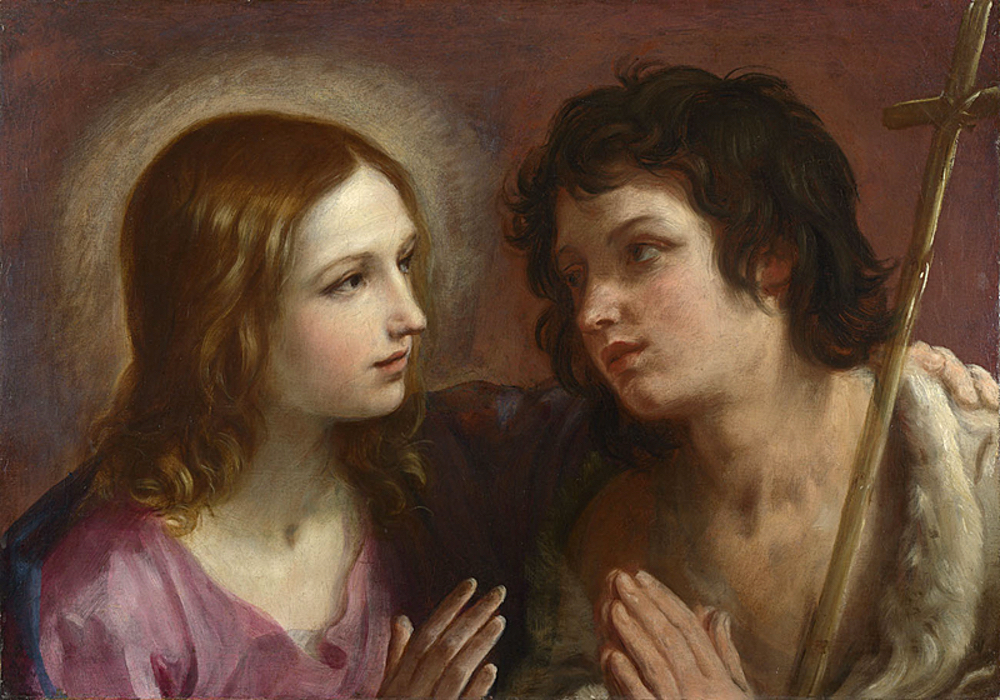
Christ embracing Saint John the Baptist (1600s), oil painting on canvas by Guido Reni (1575-1642). National Gallery, London. (Click image to enlarge.)
First Reading (Track One): Exodus 17:1-7
The people in their journey through the desert remain difficult to satisfy. They quarrel with Moses, doubting whether God is really watching over them. In last Sunday’s reading from the previous chapter of Exodus, God responded to their hunger with daily rations of quail and manna. Now they have no water. Even if their whining seems to annoy Moses, it’s hard to blame them for grumbling as they suffer from thirst. God instructs Moses to take some of the elders and go ahead of the group to strike a rock, using the same rod that he had wielded to part the Red Sea’s waters. Moses complies, and when he hits the rock, water comes gushing out to slake everyone’s thirst.
First Reading (Track Two): Ezekiel 18:1-4, 25-32
Three weeks ago we heard the Prophet Ezekiel warning the people that, although God does not desire to kill them, they surely must die if they do not repent and turn back from their wicked ways. Now we turn back a few chapters to hear a similar, longer exhortation. It’s another stern warning, but it contains a glimpse of hope. Ezekiel consistently sees repentance as the necessary response to a dangerous pattern of behavior: Fail in righteousness, refuse to be just, and you must die. But repent, turn away from wickedness, and enjoy life in the grace of God, who takes no pleasure in your death or that of your children. “Turn, then, and live.”
Psalm (Track One): Psalm 78:1-4, 12-16
Writing centuries after the ancestral story of the people’s exodus from Egypt and their journey through the wilderness to freedom, the Psalmist joyfully recalls that narrative with no hint of the quarrelsome, complaining times when the people forgot God’s blessings. In this hymn of praise that “declares the mysteries of ancient times,” these verses echo to future generations how God’s power and marvels opened the sea, led the people toward freedom, and, indeed, brought water gushing out of a cliff like a river.
Psalm (Track Two): Psalm 25:1-8
The five or six Psalms that follow immediately after the beloved 23rd Psalm also sing praise and gratitude to a loving God who cares for us and protects us from our enemies. When we sing this Psalm we echo the ideas that Ezekiel expressed: We remember that, though we may have sinned and transgressed God’s love and hopes for us, we nevertheless trust in God to remember us with compassion, protect us, and guide us toward right paths in spite of our errors.
Second Reading: Philippians 2:1-13
This week we continue in Paul’s beautiful letter written from his prison cell in Rome to his dear friends, the Philippians. Be encouraged and consoled by the life and love of Christ, he exhorts them. Be as humble and unselfish as Jesus, placing the needs of others before our own ambition; and in doing so, live as Jesus lived. Then Paul turns to the poetic phrases of one of the oldest hymns of the early church, proclaiming that Jesus – although made in the form of God – “emptied himself” in utter humility, taking instead the form of a slave, obediently accepting death by crucifixion; and in so doing became exalted as our anointed Lord and master.
Gospel: Matthew 21:23-32
We have skipped over several chapters and a great deal of activity since last week’s Gospel. Jesus and his disciples have reached Jerusalem, entered the city amid palm-waving, cheering crowds. Jesus has angrily thrown over the tables of the money changers in the temple. Now it is a new day, Jesus has come back to the temple, and the wary high priests try to trap him by asking with whose authority he teaches, heals and speaks. But Jesus traps them back with a question about John the Baptist that they can’t answer either way without getting into trouble. Then Jesus moves on to a parable that, as parables do, asks a thought-provoking question about a man who asked his two sons to work in his vineyard.