Illuminations on the Lectionary readings for Aug. 23, 2026 (Pentecost 13A/Proper 16)
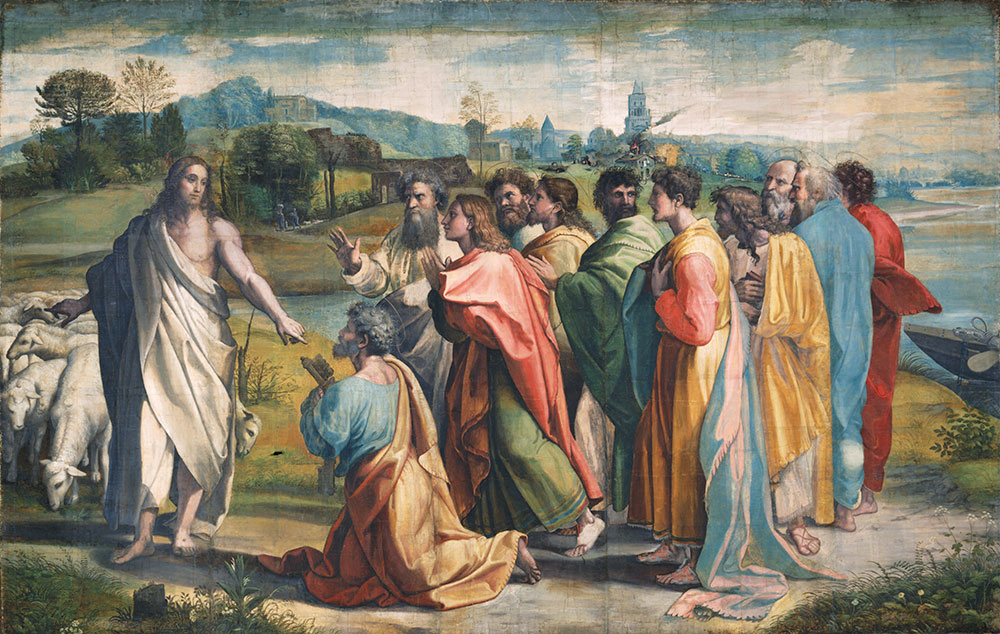
Christ’s Charge to Peter (1515-1516), painting in tempera and charcoal on paper by Raphael (1483-1520). Victoria and Albert Museum, London. (Click image to enlarge.)
First Reading (Track One): Exodus 1:8-2:10
Ideas of resistance in the face of dominant systems run like a bright thread through Sunday’s readings: the quiet, life-saving act of midwives disobeying Pharaoh, Rome’s infant Christian community joining its diverse gifts, and Peter boldly confessing that Jesus, not Caesar, is the Son of God. In this first reading, Pharaoh, fearing Egypt’s Israelite community because it has grown to threatening numbers over the years, decides to kill all the Hebrew baby boys. But two God-fearing midwives ignore the order. The baby Moses escapes in a floating basket, and Moses will eventually go on to become the next great figure in the Bible’s ancestral legends, leading the people out of Egypt on a long trek toward the Promised Land.
First Reading (Track Two): Isaiah 51:1-6
Using a metaphor that might remind us of Jesus’s response to Peter in Sunday’s Gospel, Isaiah tells the people that they were hewn from rock and dug from a quarry in their descent from Abraham and Sarah. God promised to bless Abraham and make his offspring as numerous as the stars, and that promise has been fulfilled. Although they must remain in exile now, God will deliver them eventually. God’s justice will be a light to the people, and their deliverance will come soon, Isaiah foretells: Earth may eventually wear out like a used garment and the heavens will vanish like smoke, but God’s deliverance and salvation will last forever.
Psalm (Track One): Psalm 124
The Psalmist recalls the people’s deliverance from slavery in Egypt in this hymn of thanksgiving to the God who carried them through the frightening exodus from Pharaoh’s wrath. The short psalm’s verses celebrate the people’s safe passage through the Red Sea’s raging waters. And then, in striking poetic imagery, the Psalm likens the people to a bird pursued by a hunter, escaping from a broken snare, before concluding with joyous thanksgiving: “Our help is in the name of the Lord.”
Psalm (Track Two): Psalm 138
Echoing the hope for return from exile and eventual salvation that we heard in the Isaiah reading, Psalm 138 extols God’s love and faithfulness. When we called, the Psalmist sings, God answered us and gave us strength. The litany of praise goes on: Although God is on high, God cares for the lowly; God keeps us safe when we walk in the midst of trouble. The love of the Lord endures forever and will not abandon the works of God’s hands.
Second Reading: Romans 12:1-8
Having made his case to the Christians of Rome to live and worship together in love, Paul now enters the closing chapters of this, the last of his letters. He urges the people to present their minds and bodies as a living sacrifice in spiritual worship. Do not live according to the customs of this world but discern and follow what is good in the will of God, he tells the Romans. Working out a beautiful metaphor that we also hear in 1 Corinthians, he imagines the church – like our bodies – as an organism made of many parts. Every part has its purpose, and they all must function well together to make the body work. Some lead, some teach, some give, some learn, some listen; some offer compassion. All together we make up one body in Christ.
Gospel: Matthew 16:13-20
It is surely no coincidence that Matthew places this Gospel passage at Caesarea Philippi, then a new city built as a monument to Caesar’s divine authority, with shiny temples dedicated to pagan gods and imperial worship. When Jesus asks his disciples who they say that he is – a key Gospel passage that also appears in similar form in Mark and Luke – it marks a key turning point, the moment in which Jesus first acknowledges that he is the Messiah, the son of the living God. Perhaps the disciples were already wondering about this. We are told that they worshipped him after he walked on the water and stilled the storm. But now, as Jesus and his followers begin their journey toward Jerusalem, Jesus for the first time responds affirmatively to Peter’s assertion that God has revealed him as the Messiah. Jesus then declares Peter “the rock” upon which he will build the church. But still he sternly commands the disciples not to tell anyone about this. His time has not yet come.