
Illuminations on the Lectionary readings for April 5, 2026 (Easter Sunday A – Principal Service)
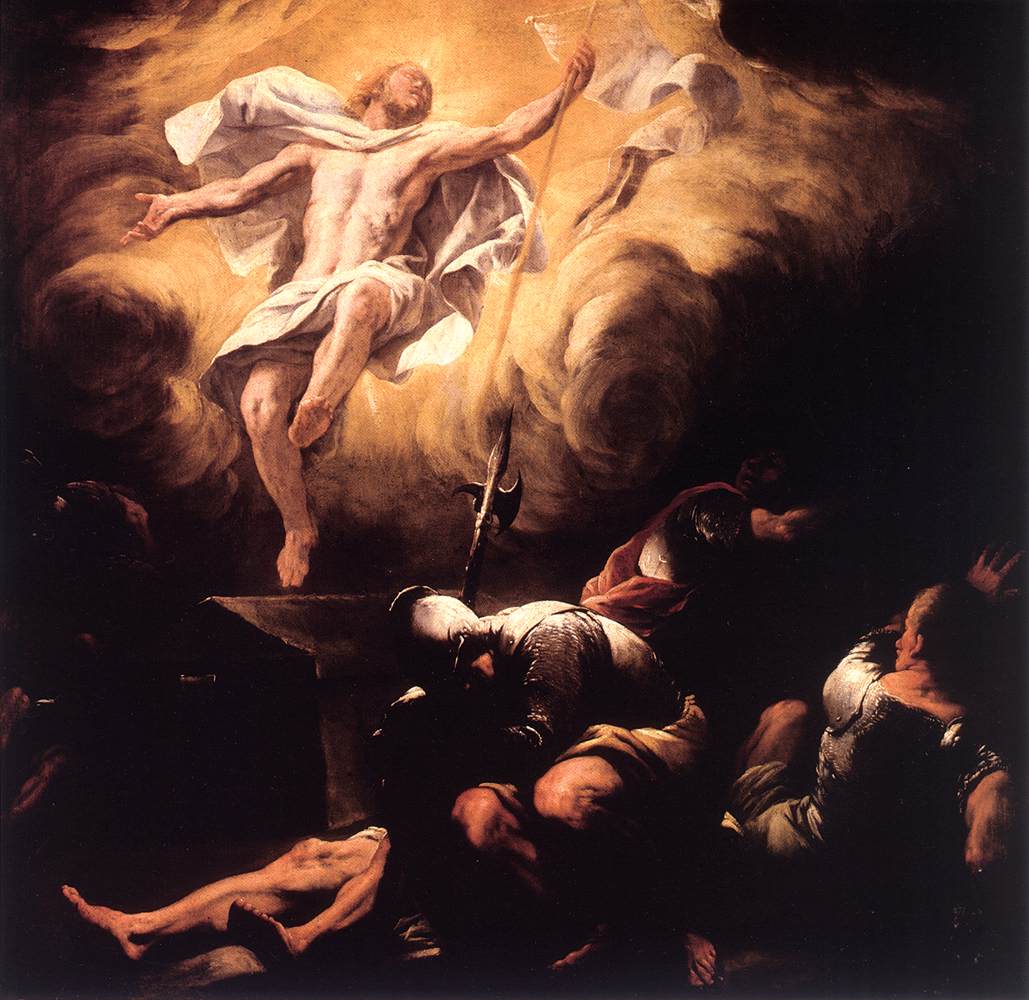
The Resurrection (1665), oil painting on canvas by Luca Giordano (1634-1705). Residenzgalerie, Salzburg, Austria. (Click image to enlarge.)
First Reading: Jeremiah 31:1-6
Easter is here! Christ is risen! The Lord is risen indeed, alleluia! We shout “alleluia,” literally “praise God,” as we celebrate the resurrection and its promise of victory over death. All our Easter Sunday readings speak of renewed life and joy. In this first reading, the prophet Jeremiah imagines a joyful scene of dance and music as the people return home to Jerusalem from exile in Babylon. They look forward to re-planting the land in new vineyards that will bear delicious fruit.
First Reading or alternate Second Reading: Acts 10:34-43
In the Acts of the Apostles, the evangelist Luke tells how Christianity reached out from its beginnings as a tiny Jewish movement to welcome all humankind. That story begins in these verses as we see Peter taking the gospel for the first time to a gentile family. Visiting the household of the centurion Cornelius, a ranking Roman army officer, a good man, and a believer, Peter assures him and his family that Jesus was sent by God to all humanity, was crucified, raised from the dead, and now saves us and forgives our sins in God’s name.
Psalm: Psalm 118:1-2, 14-24
This ancient hymn sings Israel’s joyful thanks to God for victory over its enemies. Our Jewish brothers and sisters traditionally read it during Passover, which began on the evening of Wednesday, April 1, and continues through sunset on Thursday, April 9. Christians may also imagine an allusion to Jesus in the prophetic words that the Psalmist intended to speak of King David: “The stone that the builders rejected has become the chief cornerstone.”
Second Reading: Colossians 3:1-4
Even in difficult times, Christ is with us, this short letter assures the persecuted Christians of Colossae in Asia Minor. Just as Jesus was raised from the dead, Christians are connected in baptism and raised through life in Christ, its author writing in Paul’s name assures the people. Its verses urge the people to endure their difficulties with patience and the strength that comes from God’s glorious power expressed through Jesus – not in a distant second coming but in the here and now.
Gospel: John 20:1-18
Just as multiple witnesses to any amazing event will recall details differently, each of the four evangelists differs somewhat in his account of Jesus’ friends finding the empty tomb. In the first of the two Gospels that may be read on Easter Sunday this lectionary year, John’s version tells us that only Mary Magdalene was there. John portrays her, in beautifully tender verses, as the only one who stayed at the empty tomb after everyone else left. Then, to her joyful delight, Jesus greeted her by name!
Alternate Gospel: Matthew 28:1-10
In Matthew’s account of the resurrection, two women – Mary Magdalene and Mary – go to the tomb alone at dawn. Suddenly there is an earthquake, and a bright angel descends, shows the women the empty tomb, and tells them that Jesus has been raised from the dead. The angel tells the women to go back and tell the other disciples the good news.Then, suddenly Jesus appears and greets them. They fall at his feet to worship him, and he tells them to go back and tell everyone to go to Galilee and see Jesus there.